
Introduction
Elvis Still Fills the Room: Why EPiC: Elvis Presley in Concert Is Stirring Hearts Around the World
There are stars, there are legends, and then there is Elvis Presley — an artist whose presence has never truly faded, even decades after the lights first went down. That truth is being felt once again at the global box office, where Baz Luhrmann's EPiC: Elvis Presley in Concert has become a genuine theatrical event. The film opened in IMAX on February 20, 2026, before expanding wider on February 27, and recent reporting says it has reached roughly $15 million worldwide, marking one of the strongest documentary launches in recent memory.
What makes that number meaningful is not only its size, but what it represents. This is not a nostalgia item quietly passed from one devoted fan to another. It is a large-scale communal response to Elvis as a living force in popular memory. Deadline reported that the film's one-week IMAX-exclusive launch brought in about $3.25 million from just 325 locations, a remarkable start for a documentary, before the movie expanded to far more screens in its second week.
And that is where the deeper story begins.

For many viewers, EPiC is not simply a concert movie. It feels more like a return — not only to Elvis's voice, but to the rare electricity he created between himself and an audience. Variety described the film as opening first in IMAX before moving to conventional screens, while People noted that Luhrmann built the documentary around rare footage and archival material to let Elvis's own voice and artistic intentions come forward in a more intimate way.
That matters because Elvis has often been remembered in fragments. One generation remembers the rebellious young man who changed the emotional temperature of music. Another remembers the movie star. Another remembers the white jumpsuits, the Las Vegas years, the myth, the sorrow, the legend. But EPiC appears to do something more difficult and more moving: it gathers those fragments and reminds audiences that behind every version of Elvis stood a real performer with enormous instinct, charisma, and emotional intelligence. According to The Guardian, the film draws on previously unheard taped material and restored footage from the 1970s, helping reframe Elvis not as a frozen icon, but as a vivid, complicated artist still capable of surprising people.
For older viewers especially, that can be a deeply emotional experience.
Many of them are not simply watching Elvis. They are revisiting a feeling. They are returning to a time when music seemed to carry more than melody — when it carried mood, identity, youth, memory, even hope. A giant screen and a darkened theater can do something unusual in a case like this: they can remove the distance of time. Elvis stops feeling historical and begins feeling present again.
That may explain why the film's theatrical response has been so strong. The Los Angeles Times reported that EPiC earned around $15 million and called it the third-biggest documentary opening ever, underscoring how powerful the theatrical appetite remains for music films that offer audiences a shared emotional experience.
And Elvis has always belonged to shared experience.
He was never an artist meant only for private admiration. His power came from the exchange — the glance, the gesture, the timing of a phrase, the sound of a crowd leaning toward him before it erupted. Even now, that connection seems to be the real heart of EPiC. People's reporting on the film emphasized Luhrmann's desire to show the man behind the image, while also honoring the scale of Elvis's stagecraft and the dream of reaching audiences around the world.
There is something especially poignant in that last idea. Elvis never got the true world tour he wanted, according to Luhrmann and Jerry Schilling in People's account. In that sense, the global theatrical release of EPiC becomes more than distribution strategy. It becomes a kind of delayed fulfillment — a way of sending Elvis, at last, into rooms across countries he never reached in life.
That helps explain why so many viewers describe the film not as archival, but as immediate.
Every viewing, by all accounts, seems to reveal another detail: the intelligence in a glance, the precision of a movement, the emotional weight of a note held just long enough. Those are the things true fans notice. They are also the things that keep an artist alive across generations. Greatness does not survive by accident. It survives because each return reveals something that was always there, waiting to be felt more fully.
Baz Luhrmann's long fascination with Elvis seems to understand that. Variety and Deadline both describe EPiC as emerging from Luhrmann's continuing exploration of Presley following his 2022 biopic, using rediscovered footage and restored materials to build something immersive rather than merely commemorative.
So yes, the box-office headlines matter. Yes, the IMAX opening was historic. Yes, the wider expansion gave more people the chance to see it. But the real triumph of EPiC: Elvis Presley in Concert may be something quieter and more lasting.

It reminds the world that Elvis Presley was never meant to be reduced to memory alone.
He belongs in motion.
He belongs in music.
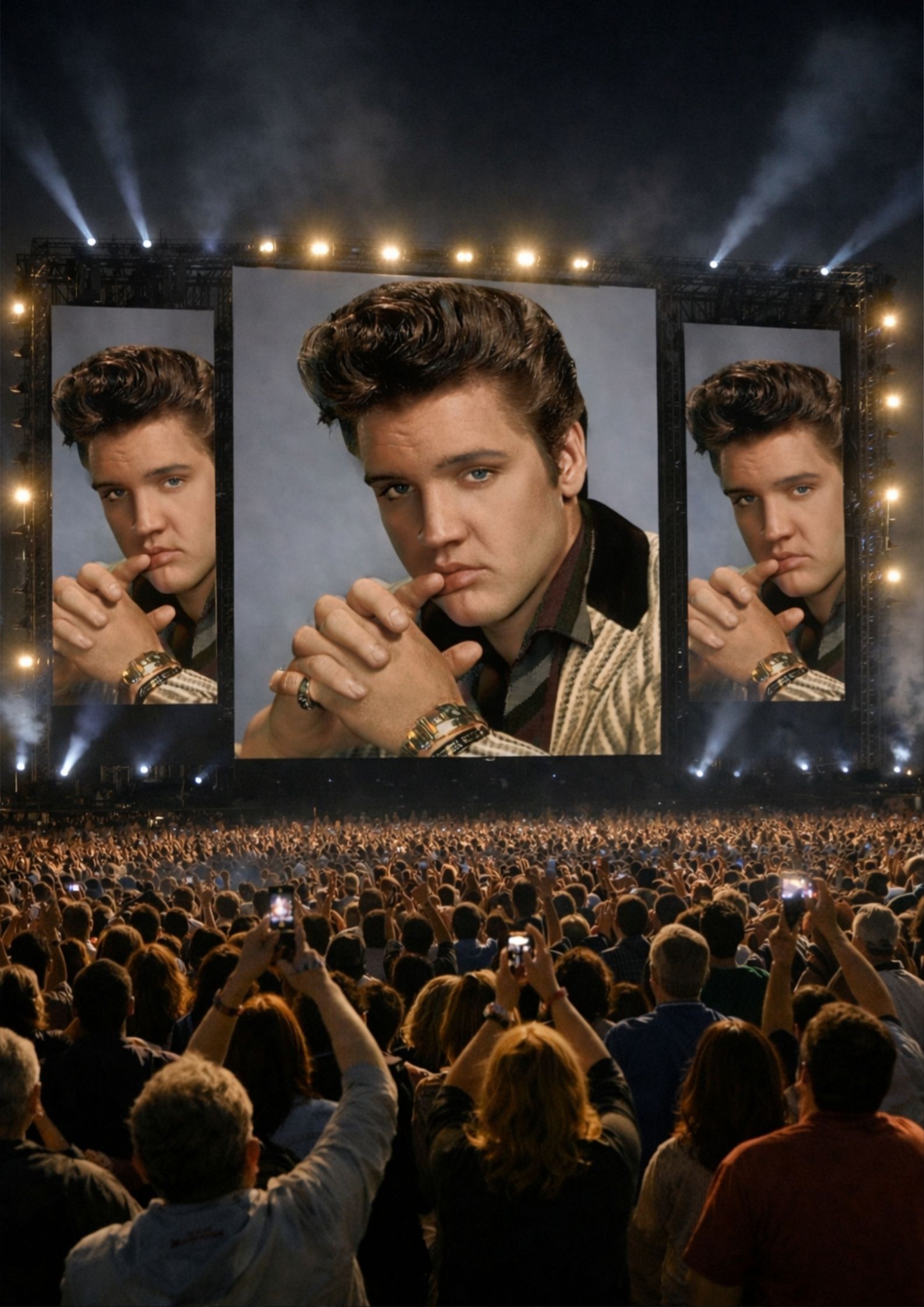
He belongs on a giant screen, commanding the room with that unmistakable mixture of tenderness, force, and mystery that no one else has ever quite duplicated.
And perhaps that is why audiences keep showing up.
Not only to remember him.
But to feel, for a couple of hours, that the King is still in the building.