

Introduction
WHEN Elvis Presley SHOOK AMERICA: THE NIGHT "HOUND DOG" CHANGED EVERYTHING ON The Ed Sullivan Show
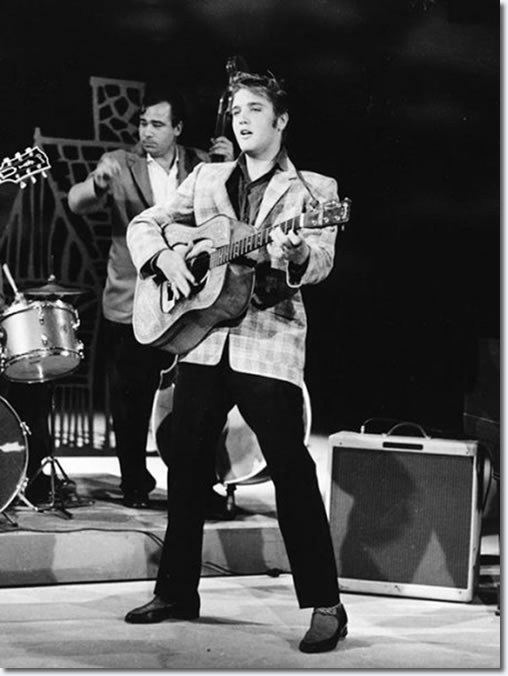
On October 28, 1956, more than 60 million Americans gathered around their televisions expecting an evening of familiar entertainment. What they received instead was something far less predictable—and far more lasting. When Elvis Presley stepped onto the stage of The Ed Sullivan Show and launched into "Hound Dog," the moment did not simply entertain. It unsettled. It divided. And, perhaps most importantly, it transformed.
To understand the magnitude of that night, one must return to the cultural atmosphere of 1950s America. It was a time defined by order, by clearly drawn social boundaries, and by a deep trust in tradition. Television, still a relatively new presence in American homes, was treated almost as an extension of the living room itself—a place where families gathered, expecting decorum, politeness, and predictability.
Into that carefully managed space walked Elvis Presley.
He was young, Southern, and impossible to categorize. His voice carried traces of gospel, blues, and rhythm and blues—sounds deeply rooted in African American musical traditions but rarely presented so openly to mainstream white audiences. Yet it was not just his voice that captured attention. It was his presence. He did not simply sing—he embodied the music.
When the opening notes of "Hound Dog" rang out, something shifted instantly.
Elvis moved in a way that felt unfamiliar, even threatening, to many viewers. His hips swayed. His posture rejected stillness. Critics would later describe the performance as "vulgar" and "animalistic," words that revealed more about the discomfort of the era than the intent of the performer. What truly unsettled audiences was not just movement—it was meaning. His performance blurred lines between race, class, and generational identity in ways America was not yet prepared to confront.
The backlash came swiftly.
Religious leaders condemned him from pulpits. Newspapers debated whether he represented a moral decline. Parents, concerned and often alarmed, questioned whether such performances belonged in the home at all. For some, Elvis Presley became a symbol of everything that felt out of control in a rapidly changing society.
Television producers responded in kind. In subsequent appearances, cameras famously avoided showing Elvis below the waist—an attempt to contain what could not easily be explained, let alone accepted. It was, in essence, an effort to restore order.
But something unexpected had already taken root.
While adults recoiled, younger viewers responded with something closer to recognition. For teenagers across the country, Elvis was not a disruption—he was a revelation. He represented a form of honesty that had rarely been visible on such a public stage. His performance of "Hound Dog" became more than a song; it became a declaration that music could belong to them, not just to the expectations of previous generations.
What many critics failed to see in that moment was the deeper cultural shift unfolding beneath the surface.
Elvis Presley was, perhaps unknowingly, acting as a bridge. His music carried the influence of African American rhythm and blues into living rooms that had long been culturally segregated. In doing so, he introduced millions of Americans to sounds and styles that had previously existed outside their immediate experience. This fusion—controversial, complex, and often misunderstood—would go on to reshape the landscape of American music.
It was not merely a performance.
It was a convergence.
Music, culture, and identity collided in a way that could not be undone.
Looking back from the distance of decades, the significance of that October night becomes even clearer. It marked a turning point—not just for Elvis Presley, but for American entertainment itself. Before that moment, popular music largely adhered to expectations of restraint and presentation. After it, something new began to emerge—something louder, freer, and far less willing to ask for permission.
Rock and roll did not begin that night, but it found its public awakening there.
And perhaps the greatest irony lies in the reaction it provoked.
The very outrage that sought to limit Elvis only amplified his reach. The criticism gave him visibility. The attempts to censor him made him more compelling. What was intended to suppress instead solidified his place in history.
For older readers who remember that era—or who have come to understand it through time—this moment carries a particular resonance. It reminds us that cultural change rarely arrives quietly. It often appears first as discomfort, as confusion, as something that does not fit within the boundaries we recognize.
Yet it is precisely in those moments that transformation begins.
On October 28, 1956, America did not simply witness a performance on The Ed Sullivan Show.
It witnessed a shift in power—from tradition to expression, from control to creativity, from silence to voice.
And at the center of it all stood Elvis Presley—not just as a singer, but as a signal.
A signal that the world was changing.
And that it would never be quite the same again.