
Introduction
When a Name Becomes a Headline: Dolly Parton, a Viral Slogan, and the Quiet Line Between Music and Politics
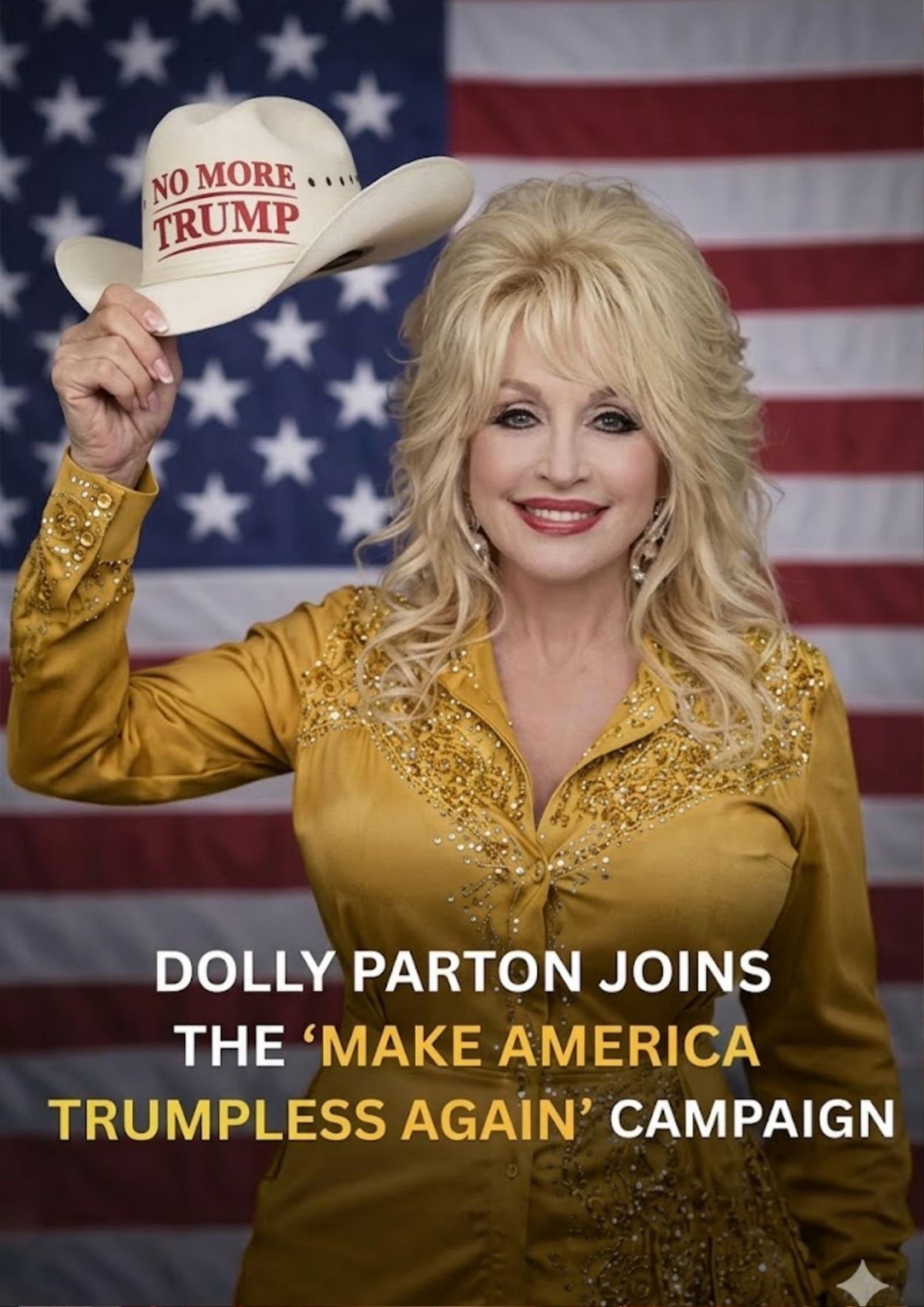
There are moments in modern culture when a single phrase—brief, striking, and easily shared—can travel farther and faster than the truth behind it. In recent days, one such phrase has found its way into public conversation, drawing attention not only for its political tone, but for the name unexpectedly associated with it: Dolly Parton.
The slogan, circulating across social media, has sparked widespread discussion after reports suggested a possible connection to Dolly Parton. Almost immediately, the internet responded in the way it often does—quickly, emotionally, and from many different directions at once. For some, the idea of a beloved cultural figure being linked to a political message felt natural, even expected in today's climate. For others, it felt unsettling, even disappointing, as though something familiar and comforting had suddenly become uncertain.
Yet what makes this moment worth examining is not simply the slogan itself, but what it reveals about the intersection of celebrity, public perception, and the rapidly shifting nature of communication in the digital age.
For decades, Dolly Parton has occupied a rare space in American life. She is not merely an entertainer, but a figure who has come to symbolize warmth, generosity, and a kind of emotional accessibility that transcends political lines. Her music—songs like "Jolene," "Coat of Many Colors," and "I Will Always Love You"—has lived in the homes and memories of millions. More importantly, her public voice has often emphasized unity over division, kindness over conflict, and understanding over judgment.
That is precisely why any suggestion of her involvement in a politically charged message draws such strong attention.

Because it feels, to many, out of character.
It is important to understand how quickly such associations can form online. In today's digital environment, phrases, images, and claims can spread widely before their origins are clearly established. A slogan may begin in one corner of the internet, gain momentum through repetition, and soon appear connected to individuals who may have had no direct involvement in its creation or promotion. By the time questions arise, the conversation has already taken on a life of its own.
In this case, the discussion surrounding Dolly Parton reflects a broader pattern that has become increasingly common. Public figures—especially those with long-standing cultural influence—are often drawn into political conversations whether they intend to be or not. Their names carry weight. Their reputations carry trust. And in a digital landscape where attention is currency, that weight can be used, interpreted, or sometimes misinterpreted in ways that extend far beyond their own words.
Reactions to the situation have followed familiar lines.
Some observers argue that artists and entertainers, like all citizens, have the right to express political opinions openly. From this perspective, figures with large audiences can play an important role in encouraging civic engagement and drawing attention to issues that matter. In recent years, many musicians, actors, and public personalities have chosen to use their platforms in precisely that way, believing that visibility can lead to awareness, and awareness to action.
Others, however, see things differently.
For many longtime fans—especially those who have followed artists like Dolly Parton for decades—music represents something separate from politics. It is a space for reflection, comfort, and shared emotional experience. A place where differences can be set aside, even briefly. When political messaging enters that space, it can feel disruptive, even divisive. Some worry that it risks changing the relationship between artist and audience, replacing connection with disagreement.
These differing perspectives are not easily reconciled, and perhaps they are not meant to be. They reflect a larger cultural question that continues to evolve: what role should public figures play in political discourse, and how should audiences respond when those roles become blurred?
What makes Dolly Parton's situation particularly notable is her long history of navigating that question with care.
Throughout her career, she has often chosen a path that emphasizes shared humanity rather than partisan identity. She has spoken about kindness, about helping others, about finding common ground even in a divided world. Her philanthropic efforts, including initiatives that support education and literacy, have reinforced that image—not as a political figure, but as a humanitarian one.
That does not mean she has avoided all public issues. Rather, it suggests that she has approached them in a way that prioritizes unity over confrontation.
And that is why the current conversation feels so delicate.
Because it touches not only on politics, but on trust.
For many people, Dolly Parton represents something steady in a changing world. A voice that has remained recognizable, reassuring, and grounded in values that feel timeless. When her name appears in connection with something unfamiliar or unexpected, it naturally invites questions—not only about the message itself, but about whether the association reflects reality.
At the same time, the moment serves as a reminder of how quickly narratives can form in the digital age. The speed of information often outpaces verification. The clarity of a headline can obscure the complexity of its origin. And the emotional response of an audience can shape a story long before its details are fully understood.
In the end, what remains most important may not be the slogan, but the perspective we bring to it.
To pause.
To consider.
To remember the larger body of work and character that define a public figure over time.
Dolly Parton's legacy has never been built on a single statement, a single moment, or a single interpretation. It has been built across decades—through music, through generosity, through a consistent effort to bring people together rather than push them apart.
That legacy does not disappear easily.
And perhaps that is the quiet lesson within this moment.
In a world where words can travel faster than understanding, there is still value in stepping back, looking deeper, and remembering who someone has shown themselves to be over the course of a lifetime.
Because sometimes, the most enduring truth is not found in what is trending.
It is found in what has lasted.